
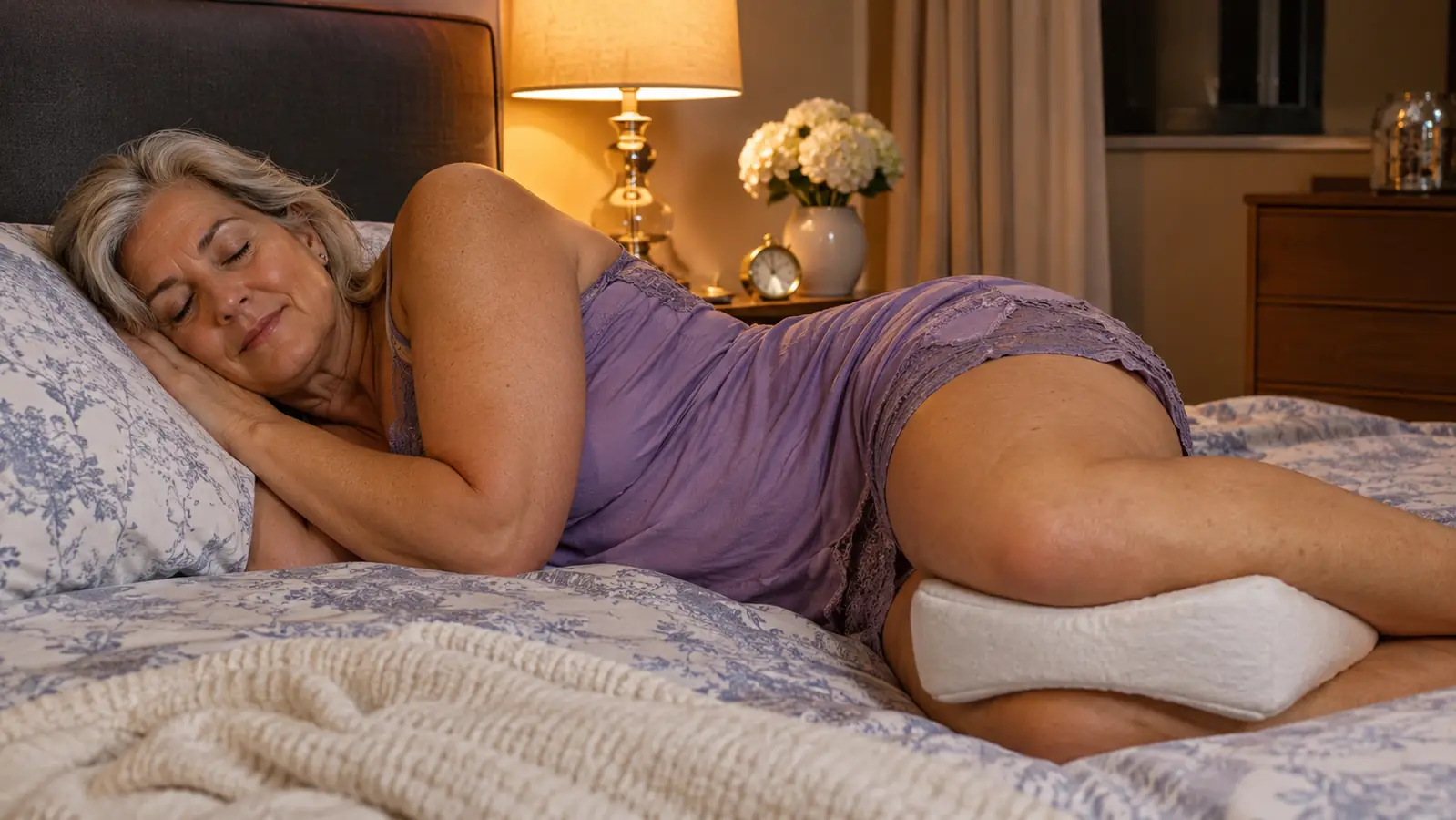
For me it started as a dull ache in my right hip around 2 a.m. I am a lifelong side sleeper, and for years I just turned over, fluffed the pillow and went back to sleep. Then, in my late fifties, the ache started staying through the morning. The ache was never sharp. It was a deep, dull complaint that faded once I was up and moving, which is why I ignored it for so long. I am 61 now, and I have slept on my side my whole life, mostly on my right side. My husband Gary sleeps on his back and runs warm, so we have never agreed on blankets, but we do agree on the mattress: a medium-firm queen, about six years old now. My doctor reminded me that ongoing hip pain is worth a conversation with a professional, and I did talk to her. She also said the way I slept was probably not helping. The culprit, it turned out, was simple: my top knee was dropping forward onto the mattress every night, letting my hip twist just enough to complain by morning. The Contour Legacy knee pillow is what finally stopped that.
A knee pillow is a small fix, but it is the fix that worked for me. I bought this one in the first week of April, with my own money, the same week I finally cleared out the stack of flat pillows on my side of the bed. I had tried ordinary pillows before, the kind you already own, and they went flat by morning. The Contour Legacy holds its shape all night, and that is the whole difference. It sits between my knees every night so my top leg stays level with my hip. It took about three nights to feel the difference and a few weeks before I stopped reaching for it automatically. Here is the exact routine I use, plus what I learned about what helps and what to skip.
The knee pillow I keep between my knees every night
The Contour Legacy is the pillow I reach for nightly. It supports both legs and knees, the foam is soft and washable, and it keeps my top hip from twisting while I sleep.
Amazon Check Today's Price on Amazon →Step 1: Lie on your side with both knees bent
Start in your usual side sleeping position. I lie mostly on my right side, with my knees bent at a comfortable angle, about the same bend I would use sitting in a chair. The goal is to get your top knee to rest directly above your bottom knee, not slung forward onto the mattress.
If you have been waking with hip pressure, watch what your top knee does when you settle in. Mine dropped forward the second I relaxed. That small drop was rotating my hip and pulling on the joint all night long. I started paying attention to it after my doctor suggested I keep a little sleep diary for a week. Every morning I wrote down whether my hip ached, and every morning it did. Just noticing the drop was the first step toward fixing it.
You do not need to change the side you sleep on. I have slept on my right side since I was a girl, and I was not about to relearn that at 61. Side sleeping is a perfectly reasonable position. You just need to keep the top leg supported so the hip stays in a neutral line.

Step 2: Place the Contour Legacy between your knees
With your knees bent, tuck the Contour Legacy between them so it sits between your thighs and knees. The pillow is about 10 inches long and 9.5 inches wide, which sounds small, but it is sized to fit between the legs without pushing them apart. The firmness description on the listing is "soft," and that is accurate. It gives just enough to hold the top leg up without feeling like a block of wood between my knees.
The Contour Legacy supports both legs and knees. That matters more than it sounds. A pillow that only fills the space between the knees lets the lower leg rest on the mattress while the top leg does all the work. This one cradles both, so the top leg stays level and the hip stays quiet. The listing lists it for knee, back and sciatica support. I bought it for my hip, and the hip is where I notice it, but I can see how the same support would help someone whose complaint starts in the lower back.
Adjust it until it feels like nothing. That is the test I use. The first night I kept second-guessing myself. I would wake up, feel the pillow, and think it had slipped. It had not. It had just settled into the curve between my thighs, which is exactly where it belongs. If I can feel the pillow pressing hard against the inside of my knee, it is too far down. If my top knee still droops, it is too far up. The right spot is the one where I forget it is there.
Step 3: Let the foam do the work, then test the line
Memory foam needs a minute to soften. The Contour Legacy uses temperature regulating foam technology that pushes heat out away from your body, so it does not trap warmth the way some foam does. I run warm at night, especially in summer, and this has never made me feel hotter. In July, when the bedroom was warm even with the window open, the pillow still felt neutral, not warm, which surprised me. Give it a few breaths to conform to your leg before you judge the fit.
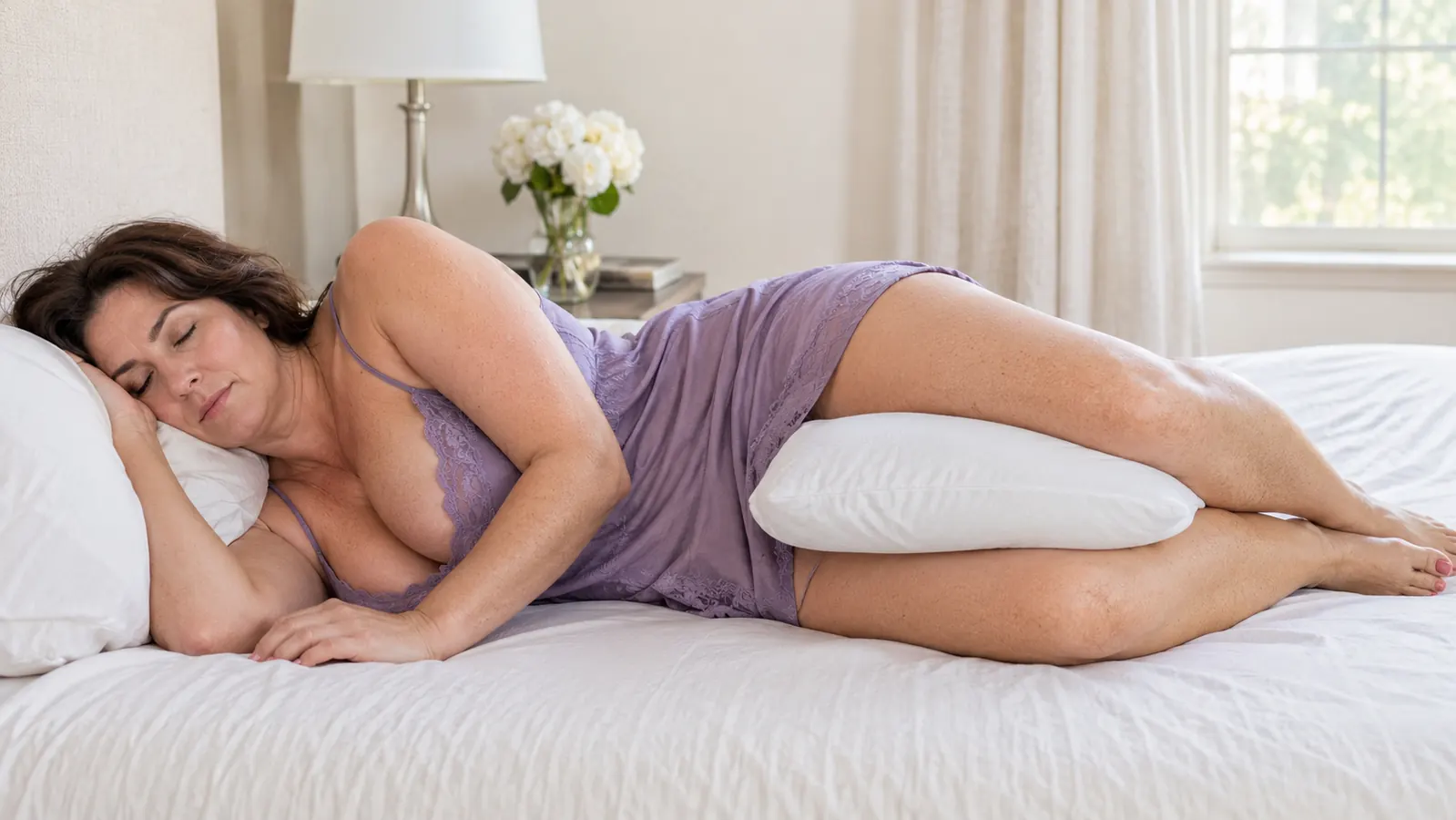
Then do the line test. Run your hand from your hip down to your knee. The top of your leg should feel like it is resting in a straight line with your hip, not angled down toward the mattress. When I first did this, I was surprised how much of a slope there was without the pillow. With the pillow, the line is level.
This is the whole job. The pillow is not doing anything complicated. It is just keeping the top knee from dropping so the hip joint does not twist all night. Simple, but it is the difference between waking up stiff and waking up ready to move. I noticed the difference most on mornings when I had to be somewhere early. Before the pillow, I would start the day by working the stiffness out of my hip while I made coffee. Now I just make the coffee.
Step 4: Keep it in place while you turn over
The first few nights I would wake up and find the pillow on the floor. I turn over a lot, and the pillow does not always come with me. The fix was to grip it lightly with my knees when I roll, the same way I would hold a book against my chest. After about a week, it became automatic. The night that convinced me it was working was the third night. I woke up at my usual 2 a.m. hip check, and for the first time in months the hip did not announce itself. The pillow was still between my knees, right where I had put it.
If you sleep with a full body pillow, you can tuck the knee pillow against it and they tend to stay together. I hug a Utopia Bedding full body pillow along the front of me, and the two pillows keep each other company through the night. Gary sleeps on his back and never touches either one, so his side of the bed is unchanged. If you do not use a body pillow, simply reach down and reposition the knee pillow when you wake. It takes two seconds.
The pillow weighs about 198 grams, so it is light enough to move with you when you roll. It is not going to anchor you to one position. It just needs to be between the knees, and it will do its job from there. I have never once been bothered by it being in the bed, and I am a light sleeper.
Step 5: Wash the cover and keep the routine going
The Contour Legacy is washable, which is the feature I did not know I needed until I had it. The cover is 62% polyester and 38% lyocell, and it comes off for washing. I wash mine every couple of weeks with my sheets and it comes out looking new. The foam inside does not go in the washer, just the cover. The listing also mentions a 1 year customer care manufacturer warranty. I have not needed it, but it is nice to know it is there.
A knee pillow is a routine, not a one-night fix. The first night I used it, I woke up with my hip still a little achy, because my body had spent decades sleeping a certain way. By the end of the first week, the morning stiffness was noticeably lighter. By the second month, I stopped thinking about my hip at night entirely. I have used this pillow every night since the first week of April, about seven months now, and the foam still holds its shape. The cover still looks the same as the day it arrived.
I also pair it with the rest of my sleep setup, and together the pieces turned our six-year-old queen bed into something that works for both of us. The knee pillow is the piece that fixed the hip. The others fixed their own problems. Gary says he cannot tell any of it is there, which is exactly what I wanted to hear.
What Else Helps
A knee pillow is the biggest piece of my hip routine, but it is not the only piece. A few other things made a real difference for me, and none of them were complicated or took any getting used to. I want to be clear that I am not a doctor and this is not medical advice. This is just what I found after about seven months of trial and error.
First, I stopped using the flat, worn pillows I had slept on for years. I switched to a Sidney Sleep adjustable curved pillow, and I removed some of the shredded foam fill in the first week to lower the loft, because the original height pushed my neck up too far. My right shoulder stopped complaining in the morning. Second, I added a VALUXE 3 inch cooling gel memory foam topper over our medium-firm mattress. It softened the surface under my shoulder and hip, and it helped me run less hot at night. Third, I hug a Utopia Bedding full body pillow along the front of me, which keeps me from rolling forward and supports my top arm so it does not go numb. I also put a cooling crescent pillowcase on my head pillow so my cheek stays cooler.
If you only change one thing, start with the knee pillow. It is the smallest change and it targets the hip directly. It is also the smallest experiment, which matters when you have already tried sleep gadgets that did nothing. If your hip still aches after a few weeks, or if the pain is sharp or new, please talk to a doctor or physical therapist. No pillow treats an injury, and the right professional advice is worth more than any sleep gadget.
The pillow is not doing anything complicated. It is just keeping the top knee from dropping so the hip joint does not twist all night.
Give your hip a level place to rest tonight
The Contour Legacy Leg and Knee Foam Support Pillow is the one I have used nightly for about seven months. It is soft, washable, and sized to fit between your knees without pushing them apart.
Amazon Check Today's Price on Amazon →