

Seven months ago, I tucked the Contour Legacy Leg and Knee Foam Support Pillow between my knees for the first time. I am a 61 year old side sleeper, and my right hip had been waking me up for a couple of years. I bought it in the first week of April, and it has been between my knees every night since. That is the short version. The longer version is about what it does, what it does not do, and why I kept it when I have sent other sleep gadgets to the back of the closet.
I will start with the honest part. A knee pillow is not a medical device, and it will not fix an injured hip or a bad disc. If your pain is sharp or getting worse, please mention it to a doctor or a physical therapist. What a knee pillow can do is keep your top leg from dropping forward while you sleep, and that small mechanical change can take a surprising amount of strain off your hip and lower back. That is the job the Contour Legacy does for me.
The Quick Verdict
The Contour Legacy is the knee pillow I kept after trying several. It keeps my top knee from dropping, eases the pull on my right hip, and has held its shape for seven months of nightly use.
Amazon Check Today's Price →The knee pillow that stayed between my knees for seven months
I bought the Contour Legacy in April and used it every night since. If you are a side sleeper waking with an achy hip, this is the one I would start with.
Amazon Check Today's Price on Amazon →How I've Used It
I am a lifelong side sleeper, mostly on my right side. In my late fifties I started waking with a stiff right shoulder, a sore neck, and an achy right hip. My husband Gary sleeps on his back and runs warm at night, so we share one queen bed with a medium-firm mattress that is about six years old. I have never been someone who sleeps perfectly still, so whatever I put in the bed has to survive me turning over a few times.
I bought the Contour Legacy in the first week of April. Every night I put it between my knees, with the soft memory foam cradling the top leg. It keeps my top knee from dropping forward, which is the movement that twists my hip. I have used it every night for about seven months now, and it has become as routine as pulling up the sheet.
The first night felt a little odd, I will admit. I had never slept with anything between my knees before, and I kept reaching down to check that it was still there. By the third night it felt normal, and by the end of the first week I stopped thinking about it entirely. That is my real test for any sleep product: not whether it works on night one, but whether it disappears into the routine by night ten. The Contour Legacy passed that test somewhere in the second week of April.
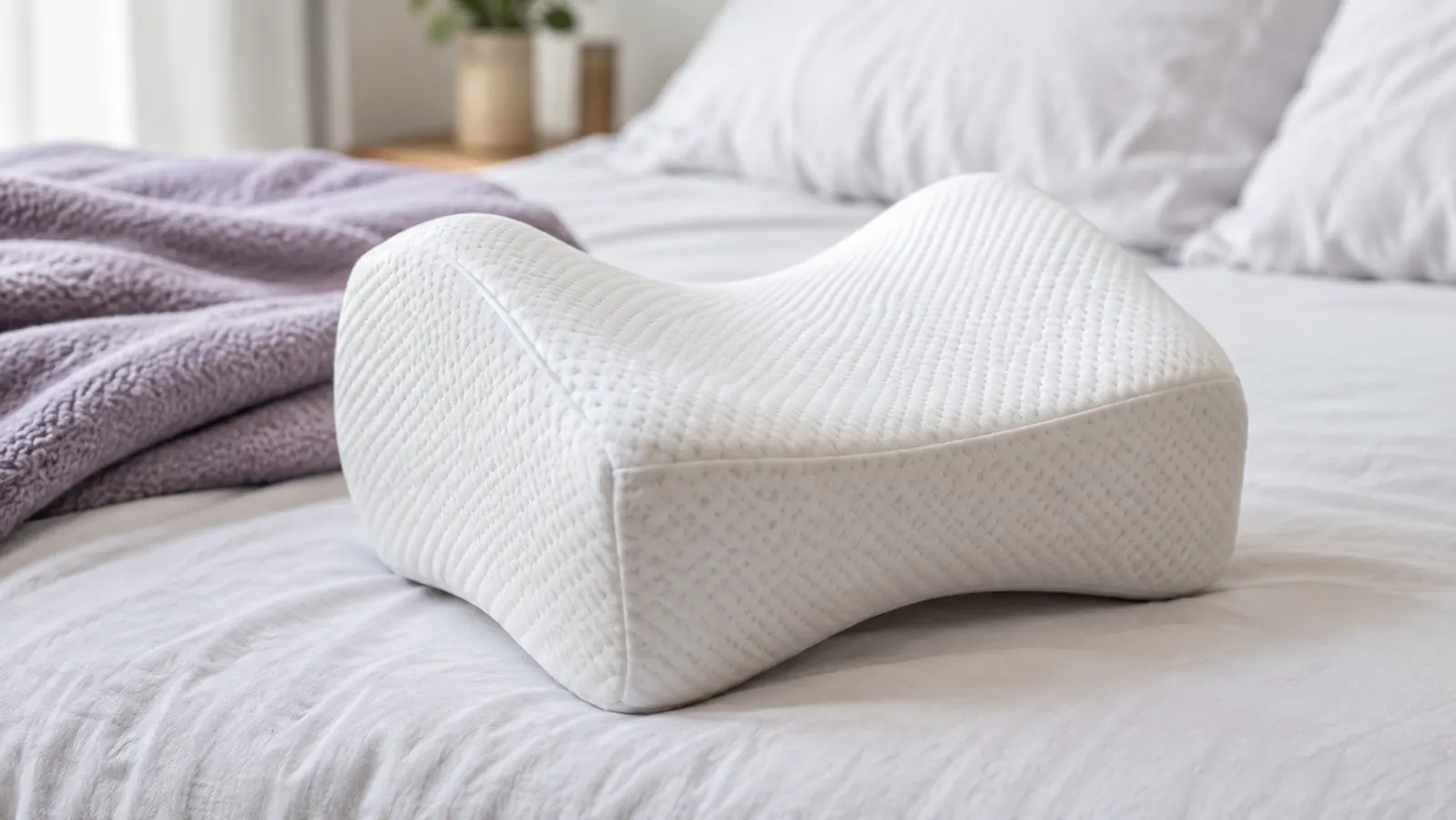
It is small, about 10 inches by 9.5 inches, and it weighs next to nothing at 198 grams. It does not take up room in the bed, and Gary says he does not even notice it. For a bed that is already shared, that matters more than you might think.

What the Contour Legacy Actually Does
The idea behind a knee pillow is simple. When you sleep on your side with your legs stacked, the top leg tends to drop forward. That pulls on the hip joint and can twist the lower back. The Contour Legacy sits between your knees and gives the top leg something to rest on, so it stays roughly in line with your hip.
The fill is memory foam, and the firmness is soft. That softness is important. A hard pillow between your knees is uncomfortable and can actually push your joints out of line. The Contour Legacy is soft enough to cradle the leg but supportive enough to keep it from dropping. The cover is 62 percent polyester and 38 percent lyocell, and the whole thing is washable, which I appreciate more than I expected to. The listing says it supports both your legs and knees, and that matches what I feel.
The listing also mentions temperature regulating foam technology that pushes heat outward, away from your body. I run warm at night, especially in summer, so I was curious whether I would notice it. I cannot give you a lab measurement, but I can tell you I have not woken up with damp knees the way I did with some foam pillows in the past. It also comes with a one year manufacturer warranty, which is a small comfort on a pillow you plan to use every night.
Seven Months of Nightly Use
I will be honest: I did not expect to still be using this pillow in November. I have been through several ordinary pillows that went flat within a few weeks, and I have bought more sleep gadgets than I like to admit. Most of them ended up in the back of the closet. The Contour Legacy is one of the few that earned its place in the bed.
The test for me has always been my right hip. Before this pillow, I would wake up and feel it the moment I stood up, a deep ache that took a few minutes to loosen. Now, most mornings I do not think about it at all. It is not a cure, and I would never claim it is. But it took the specific strain out of the way I sleep, and that has made a real difference.
I also noticed something I had stopped noticing: my knees used to press together at night. It was a minor annoyance, the kind of thing you forget about until it is gone. With the pillow between my knees, that pressure is simply not there anymore. After seven months, the foam still holds its shape. It is soft, but it bounces back, which is more than I can say for the flat pillows I used before.
One thing I did not expect is how much I would notice when I forgot it. A few times I fell asleep without it, and I woke up with that familiar pull in my hip. One night in late August I fell asleep on the couch after a long day and never made it back to bed properly. I woke up around 3 in the morning, walked to the bedroom, and felt that old ache in my hip with every step. It loosened up by mid-morning, but the contrast was hard to miss. It is a good reminder that the pillow is doing something, even if it is easy to take for granted.
Seven months in, the foam still holds its shape, and my right hip is the reason I still reach for it every night.
The Tradeoffs I Noticed
No review is honest without the tradeoffs, so here are mine. The Contour Legacy is a single purpose pillow. It is made for between your legs, and that is where it works. It is not a head pillow, and it is not a back support, even though the listing mentions back and sciatica support as possible uses. For me, it is a leg pillow, and I use it that way.
Because it is soft, it does not force your legs into position. You have to place it correctly when you settle in, and if you move a lot in the night, it can shift. I wake up a few times a week and find it has moved, and I just tuck it back. It takes two seconds. If you want a pillow that stays put no matter what, you might prefer one with a strap, but I have not found the shifting to be a real problem.
How It Compares to What I Tried Before
I do not want to name the ordinary pillows I used before, because they were not bad pillows. They were just not the right shape for this job. A flat pillow between your knees tends to squish down to nothing by morning, and then your top leg drops again. A rolled up blanket works for about an hour. The Contour Legacy has enough structure to stay between my knees all night, and that is the difference.
I remember the night I tried the rolled up blanket. I folded one from the hall closet into a long roll, tucked it between my knees, and felt very clever about it. Sometime around 2 in the morning I woke up and the blanket had worked its way down to my ankles. The flat pillow version lasted longer, but not by much, and by morning it was a thin pancake under my leg. Those two experiments are the reason I finally went looking for a real knee pillow in the first place.
I also considered a strap on knee pillow, because I know some people swear by them. I decided to try the Contour Legacy first because it is simpler and because I was not sure I wanted something cinched around my leg while I slept. For my sleep, the simple version has been enough. If you toss a lot, a strap might be worth considering, but I have not needed it.
If you are a side sleeper and your hip or lower back has been bothering you, a knee pillow is one of the simplest things to try before you move on to anything more involved. The Contour Legacy is a good version of that idea. It is soft, it is washable, it is small enough to share a bed, and after seven months it still has not gone flat.
A Few Practical Notes
The Contour Legacy comes in a single pack, and the size is 10 inches by 9.5 inches, which is smaller than I expected. That turned out to be a good thing. It fits neatly between my knees without pushing my legs apart in a way that felt awkward. The item weight is 198 grams, so it is easy to move around or take with you if you travel.
I took it with me once, on a weekend trip in September. It fit easily in my overnight bag, which surprised me, since I half expected a knee pillow to be bulky. The bed there was softer than mine, and the pillow still did its job. It is not something I would have thought to pack before that weekend. Now it goes in the bag without a second thought.
Washing it is straightforward. The cover is 62 percent polyester and 38 percent lyocell, and the special feature listed is washable. I have washed it a few times on a gentle cycle and let it air dry, and it has held up fine. I cannot tell you whether the memory foam inside is removable, because I have not tried to take it apart, and I do not think you need to.
One more note: the shape is called a leg pillow, and it is shaped for that job. Do not expect it to work as a neck roll or a lumbar cushion. It is soft and flexible enough that you could probably fold it into other jobs, but I have not needed to. It has one job in my bed, and it does it well.
I have bought a lot of sleep things over the years, and most of them are in a drawer or the back of a closet. The Contour Legacy is not one of those. It is the pillow I reach for every night, and it is the one I would buy again if I needed to. That is the highest praise I can give a sleep product.
What I Liked
- Keeps my top knee from dropping, which takes pressure off my right hip
- Soft memory foam that still holds its shape after seven months of nightly use
- Small and light at 10 by 9.5 inches and 198 grams, so it does not crowd a shared bed
- Washable cover and temperature regulating foam, helpful for someone who runs warm
- One year manufacturer warranty
Where It Falls Short
- It is a single purpose pillow, so it will not replace a head pillow or a back support
- Soft means you have to position it yourself, and it can shift if you move a lot
- It does not force your legs into place, so it will not help if you want a pillow that stays put on its own
Who This Is For
If you are a side sleeper who wakes with an achy hip, or if your knees press together at night, the Contour Legacy is worth trying. It is also a good option if you run warm and want a foam pillow that does not trap heat. It is a simple, low commitment thing to test before you spend money on anything more complicated. I would start here.
One more thing: if you share a bed, this pillow is quiet. There is no crinkling and nothing that makes noise when you turn over. Gary has never once complained about it, and he complains about plenty.
Who Should Skip It
If you sleep on your back or your stomach, a knee pillow probably will not do much for you. If your hip or back pain is sharp, or if it is getting worse, please mention it to a doctor or a physical therapist. No pillow treats an injury. And if you want something that stays exactly where you put it no matter how much you toss, you might prefer a strap on model. The Contour Legacy is soft and simple, and I have to tuck it back a few times a week.
Seven months later, it is still between my knees
The Contour Legacy is the knee pillow I kept. If you are a side sleeper with an achy hip, it is worth a try.
Amazon Check Today's Price on Amazon →