

I have slept on my side my whole life, mostly on my right side, and for most of those years I never gave the mattress a second thought. Then, in my late fifties, I started waking up with a stiff right shoulder, an aching right hip, and a neck that felt tight before I even sat up. Some mornings my arm tingled, too. I told myself it was just age, and maybe part of it is, but I also started to notice that the bed itself was part of the problem. The pattern was hard to miss: I would go to bed feeling fine, and I would wake up feeling like I had spent the night wrestling something.
Our queen mattress is medium-firm and about six years old. It is not a bad mattress. It is just firmer than my shoulder and hip want it to be, and I am a side sleeper, so all my weight lands on those two spots every night. I tried the usual things first. Extra pillows, a padded mattress pad, different sleeping positions. None of it changed much. What finally helped was a three-inch cooling gel memory foam topper from VALUXE, and the way I put it to use. If you are waking up with the same kind of pressure and you are not ready to replace a perfectly good mattress, here is how I would go about it.
Soften the mattress where your shoulder and hip actually land
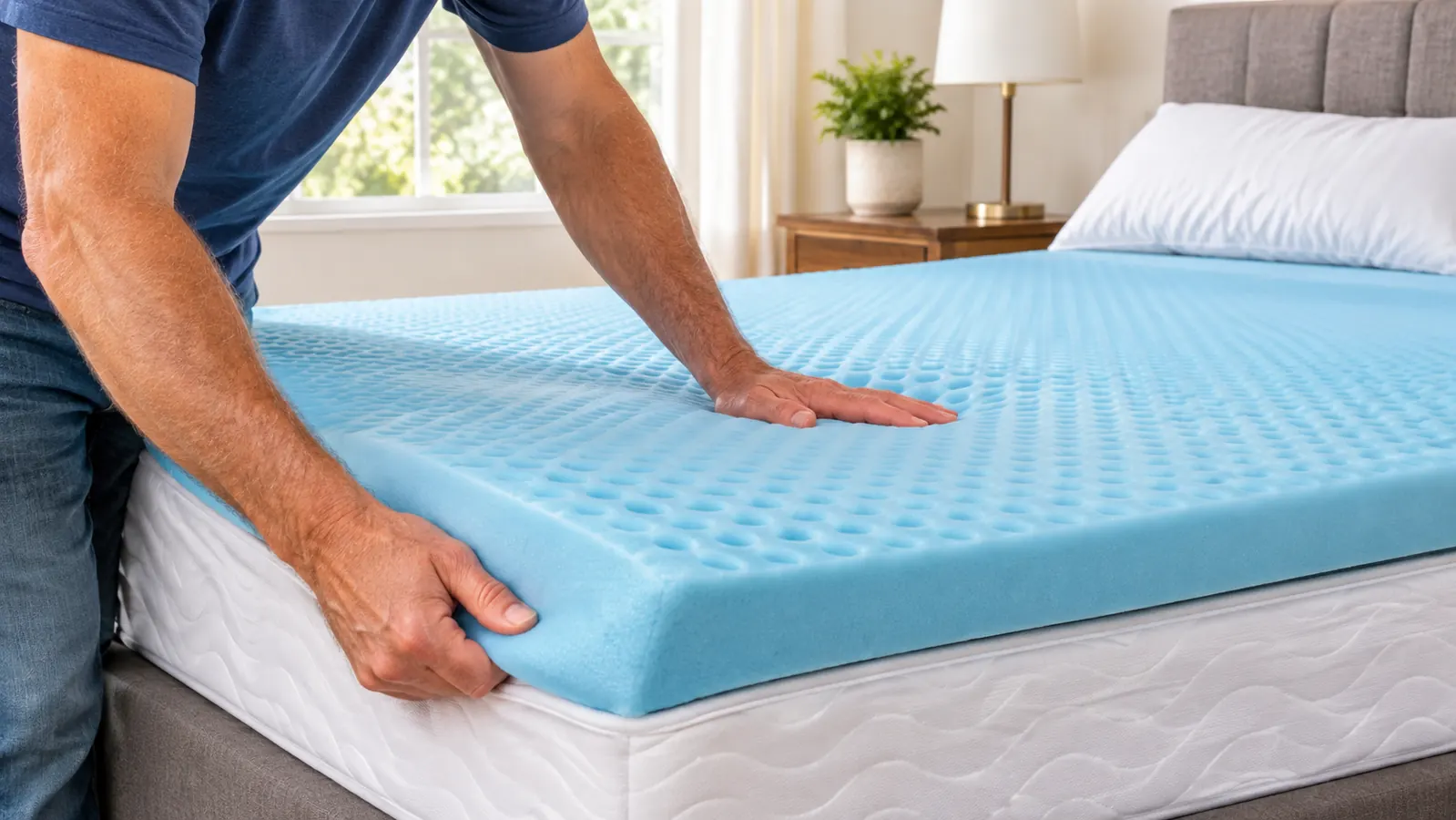
A 3-inch layer of VALUXE cooling gel memory foam cushions the pressure points that keep side sleepers awake. It is soft, breathable, and spot cleans in place. See today's price on Amazon.
Amazon Check Today's Price on Amazon →Step 1: Figure Out Where the Pressure Actually Is
Before you buy anything, lie down on your bed the way you normally sleep and pay attention to where you feel pressure. For me, it was the point of my right shoulder and the outside of my right hip. I could feel the firmness pushing back at both spots within a minute or two. That told me the mattress was not supporting me, it was fighting me. I did this test three nights in a row, because I wanted to be sure it was the bed and not just one bad night.
This matters because a topper is not a new mattress, and it is not a cure for an injury. If your shoulder, hip, or neck pain is new, sharp, or getting worse, that is worth mentioning to a doctor or a physical therapist. I am not a medical person, and I do not want to sound like one. What I can tell you is that my own aches were the kind that showed up overnight and faded as I moved around in the morning, and that pattern pointed me toward the bed. Once I understood that, the topper stopped being a gamble and became the obvious next step.
It also helped to check the mattress for obvious wear. Ours is six years old and still in decent shape, just firm. If your mattress is sagging, lumpy, or more than ten years old, a topper will only do so much. In that case, the honest answer might be a new mattress, and the topper becomes a stopgap rather than a fix.
Step 2: Pick a Thickness That Matches How You Sleep
The VALUXE topper comes in two-inch, three-inch, and four-inch thicknesses, and this is the choice that matters most. I went with the three-inch version, and I will tell you why. Two inches felt like it might soften the surface without giving enough cushion under the heaviest points, my shoulder and hip. Four inches sounded lovely, but I share the bed with Gary, who sleeps on his back and does not want to feel like he is sinking into a cloud. Three inches was the middle ground, and for our queen bed it has been the right one. It is enough to feel the difference the first night, but it does not change the character of the mattress entirely.
Your own choice depends on your weight, your sleeping position, and how firm your mattress is. A lighter person on a very firm mattress might find two inches plenty. A heavier person, or someone with a truly hard mattress, might want the four-inch version. If you are a side sleeper like me, give yourself the extra cushion at the shoulder and hip. That is where the pressure is worst. I would rather have a little too much cushion than not enough, because a topper that is too thin just becomes another layer you stop noticing.
One practical note about the four-inch version: it can take up to 72 hours to fully expand at room temperature, while the three-inch version is fully expanded within 48 hours. If you need the bed ready quickly, that is worth knowing before you choose. I mention it because the waiting is the least fun part of the whole process, and it is easier to plan for.
Step 3: Give the Topper Time to Expand Before You Put Sheets On
When the box arrives, the topper will be compressed and rolled tight. That is normal. Take it out, lay it on the bed, and let it breathe. The VALUXE is made of memory foam with cooling gel infused in it, and it needs time to puff back up to its full three inches. I unpacked ours in the morning and left it flat on the mattress with the bedroom door closed. I will admit I peeked at it a few times during the day, the way you check on bread dough, and it was visibly thicker by the afternoon.
The manufacturer says it fully expands within 48 hours at room temperature, and mine was close to full by the next evening. Do not put the sheets on too early and do not sleep on it while it is still compressed. You will not hurt it, but you will not get a fair test of how it feels either. Give it the full two days if you can. I know that sounds like a long time when you are excited to try something new, but it is one weekend, and it saves you from deciding the topper does not work when it was never fully fluffed in the first place.
A couple of care notes from the label: it is spot clean only, and it is not water resistant. That means no soaking it, no running it through a washing machine, and no letting a wet glass sit on the bedside table above it. A damp cloth for a small spot, and that is about it. Keep a fitted sheet over it and it will stay clean for a long time. I have only had to spot clean ours once, and it took less than a minute.

Step 4: Put It on the Mattress and Give It a Few Nights
Once it is fully expanded, the topper goes on top of the mattress, under your fitted sheet. It has a pull-on fit, so it stretches over the corners of the mattress and stays put while you sleep. Gary and I put ours on together, pulling it over each corner in turn, and it took about two minutes. The fitted sheet went back on over it without any fuss, which surprised me. I had expected wrestling and swearing.
The first night felt different, and different can be unsettling. The surface was softer under my shoulder and hip, and I noticed I was not shifting around as much. It took me about three nights to stop thinking about it, and that was the point. By the end of the first week, I was waking up without that deep ache in my right hip, and the stiffness in my shoulder was noticeably milder. I did not expect a topper to do that much, and I am still a little surprised that it did.
Gary noticed the difference on his side too, but not in a bad way. He sleeps on his back and runs warm, and the cooling gel is designed to dissipate heat rather than trap it. He has not complained about overheating, which, for Gary, is practically a review. I run warm myself, especially in summer, and the topper has not made that worse. If anything, it feels cooler than the bare mattress did. That was the part I did not expect. I bought the topper for pressure, and the temperature benefit turned out to be a bonus.
Step 5: Pair the Topper With Pillows That Line Up Your Neck and Hips
The topper fixed the mattress, but it cannot fix your pillow. I learned this the hard way. For years I used ordinary pillows that went flat by morning, and my neck paid for it. What finally worked was a curved pillow that I could adjust. I took some of the shredded foam fill out of mine in the first week to lower the loft, and that kept my neck lined up with my spine and took pressure off my right shoulder. The topper took care of the surface, and the pillow took care of the alignment. I needed both.
For the hip, a knee pillow made the biggest difference. I put one between my knees every night, and it keeps my top knee from dropping and twisting my hip. I also hug a full body pillow along the front of me, which keeps me from rolling forward and gives my top arm somewhere to rest so it does not go numb. The topper softens the surface underneath all of it, and the pillows keep my body in line on top of it. Together they solved a puzzle I had been poking at for a couple of years.
If you only change one thing, change the mattress surface. But if you are a side sleeper, the pillows are what make the topper work. They all work together, and none of them is a substitute for the others. I would not go back to the way I slept before, and I do not say that about many purchases.
What Else Helps
A few things that are free or close to it. I started going to bed at a more regular time, which helped more than I expected. I keep the bedroom a little cooler in summer, and I switched to cotton sheets that breathe. I also do a few gentle stretches before bed, nothing dramatic, just enough to loosen my shoulders. And I will say the same thing I said at the start: if the pain is persistent or getting worse, please talk to a doctor or physical therapist. A topper is a comfort tool, not a treatment. It cannot diagnose anything, and it should not be asked to.
One more honest note. The VALUXE topper has worked well for us for about seven months now, and it still feels as soft as it did in the first week. It has 914 reviews on Amazon and a 4.4 rating, which is the kind of number that made me willing to try it in the first place. It comes with a three-year limited warranty, and it has held its shape through nightly use. I cannot promise it will work for your exact mattress and your exact body, because that depends on a lot of things. But if you are a side sleeper waking up with pressure in your shoulder and hip, it is the first thing I would try. It was the first thing that worked for me.
Three nights in, I stopped noticing the mattress at all. That was the first time in a year I could say that.
The VALUXE topper that softened our medium-firm queen
Three inches of cooling gel memory foam, a pull-on fit that stays put, and a 3-year limited warranty. If your shoulder and hip are telling you the mattress is too firm, this is the fix worth trying first.
Amazon Check Today's Price on Amazon →