

I will give you the short answer first, because that is what I wanted when I was hunting for this comparison. If you sleep on a curved side sleeper pillow, the ELIBABA Cooling Side Sleeper Curved Pillowcase is the one I kept and the one I would buy again. If you sleep on a plain rectangular pillow, a standard cooling pillowcase will do the job for less money, and you can stop reading right here.
To explain why, I have to tell you about my own pillow. I am a side sleeper, mostly on my right side, and in my late fifties I started waking with a stiff right shoulder, a sore neck, and sometimes a tingling arm. Since the first week of April I have slept on the Sidney Sleep adjustable curved pillow, and it made a real difference for my neck and my right shoulder. But the case that came with it slid around, bunched under my cheek, and held heat on warm nights. Gary sleeps on his back and runs warm, and on summer nights we both notice the difference in our bedding. So I went looking for a case made for a crescent shaped pillow, and I have used the ELIBABA on that pillow almost every night since. This is the comparison I wished I had found back then, written by someone who actually slept on both.
| ELIBABA Curved Pillowcase | Standard Cooling Pillowcase | |
|---|---|---|
| Fit for curved pillows | Made for crescent side sleeper pillows, 20" x 30" | Slips and bunches on a curved pillow |
| Fit for rectangular pillows | Not designed for flat pillows; the curve leaves gaps | Fits standard rectangular pillows easily |
| Cooling material | Rayon derived from bamboo, thermo-regulating, 400 thread count | Cooling finish on cotton or polyester that can fade with washing |
| Stays in place overnight | Zipper closure keeps it snug on the pillow | Open end can slide off a curved pillow |
| Cost | Costs more, made for one specific pillow shape | Costs less and easy to find anywhere |
| Care | Machine wash cold, zip it up first | Usually machine washable too |
| Color and style choices | One solid pattern, made for a specific shape | Many colors and patterns to match a bedroom |
Why the Shape Matters
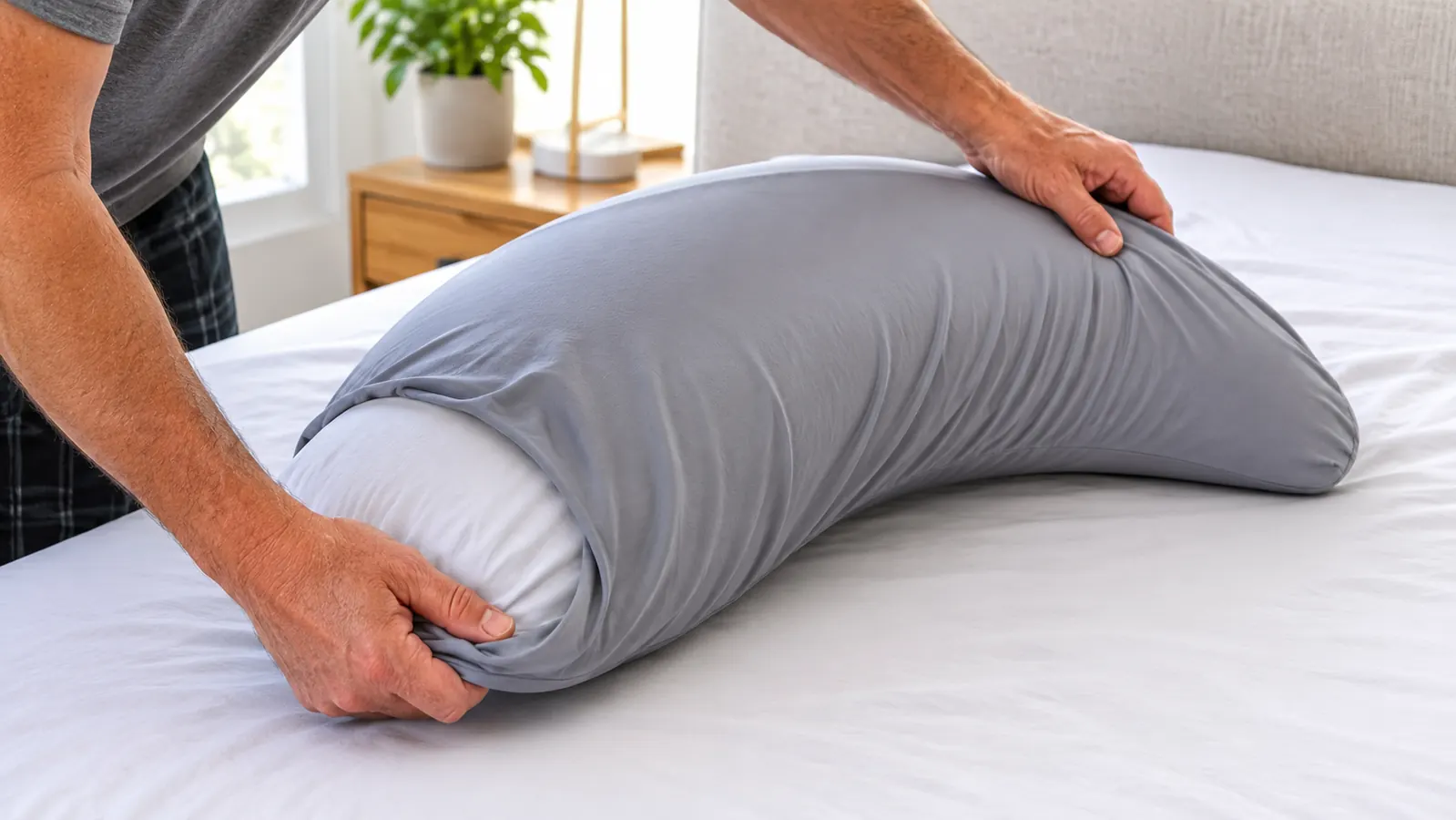
The shape is the whole story, so it deserves its own section. A standard pillowcase is a rectangle sewn shut on three sides. It works because a standard pillow is also a rectangle. A curved side sleeper pillow is shaped to support your neck and shoulder, with a lower area where your head rests and a curve that follows the line of your shoulder. A rectangle does not follow that shape. It pulls at the ends, it wrinkles across the middle, and it slides off the tapered parts of the pillow.
The ELIBABA is a crescent pillowcase, cut to match that curve, with a zipper to hold it in place. The difference is not subtle. The first night I used it, I noticed that my cheek was resting on smooth, flat fabric instead of a lump of gathered cotton. That is the whole point of a curved pillowcase, and it is the reason I tell people not to judge this product by how it looks folded on a shelf.
How I Compared Them
For the record, I did not test these side by side in a laboratory. I slept on the ELIBABA on my Sidney Sleep curved pillow for about seven months, and I compared it against two things: the case that came with the pillow, and the flat cotton cases I had used for years on ordinary pillows. That is the comparison that matters to a side sleeper, because it is the one you will actually live with night after night.
I paid attention to the things that usually bother me. Does the case slide off during the night? Does it bunch up under my cheek? Does it feel hot against my face by three in the morning? And does it survive the washing machine? I washed it on cold with the zipper done up, the way the care tag says, and I watched how the fabric held up over the months.
Where ELIBABA Wins
The first thing I noticed was the fit. A curved pillow looks a little like a crescent, and a flat case simply does not follow that shape. It gathers at the ends and pulls tight across the middle, and before long you are sleeping on a wrinkle. The ELIBABA is cut for that curve, so it hugs the pillow instead of fighting it. The zipper closure is the detail I did not know I needed. I zip it up, smooth it once, and it stays put all night. I do not wake up with fabric wadded under my ear anymore, and that alone was worth the switch. On nights when I turn from my right side to my left, the case moves with the pillow instead of twisting against it.
The fabric is the second reason I kept it. It is rayon derived from bamboo with a 400 thread count, and it feels smooth and almost silky against my cheek. The listing says bamboo rayon usually runs about three degrees cooler than cotton and is thermo-regulating, which matches what I feel on warm nights. I run warm, especially in summer, and this case does not trap heat the way my old one did. It is also fade resistant, and after seven months of washing it still looks the same as the day it arrived. I wash it on cold with the zipper closed, and it comes out clean and smooth every time. A pillowcase that touches your face for eight hours a night needs to feel good, and this one does.
The size is worth a note. It is a queen size at 20 by 30 inches, and the listing says it is designed to fit most crescent side sleeper pillows. I cannot promise it will fit every curved pillow on the market, because pillow shapes vary, but it fits my Sidney Sleep pillow without any loose fabric or tugging. I removed some of the shredded foam fill from that pillow in the first week to lower the loft for my neck, and the case still fits snugly over the smaller shape. If you own a curved pillow and you are not sure, measure it before you order. That is the practical advice I would give anyone.
Where a Standard Cooling Pillowcase Wins
I am not going to pretend the standard case is a bad product, because it is not. It costs less, it is sold in every big store and online shop, and it comes in more colors and patterns than you can count. If your pillow is a normal rectangular one, a standard cooling pillowcase is the sensible buy. You do not need a specialty case for a pillow shape you do not have. That is the whole argument, and it is a fair one. I have used standard cases for most of my life, and they are fine on a flat pillow.
There is also something to be said for simplicity. A standard case is easy to swap with the rest of your bedding, easy to replace, and easy to find if you forget to pack one for a trip. The ELIBABA is a specialty item. It is made for one kind of pillow, and if you ever switch back to a flat pillow, the curve will leave loose fabric and gaps that will annoy you. I also found that some standard cooling cases are perfectly fine if you only need a little cooling on a few hot nights. I needed more than a little, and I needed a case that would stay on a curved pillow, which is why I landed where I did.
One honest note about the standard cases I have owned: the cooling effect often comes from a finish on the fabric, and that finish can fade after repeated washing. A bamboo rayon fabric cools because of the material itself, not because of a coating. That difference matters if you plan to use the case for years, the way I do. But if you replace pillowcases often anyway, or if you only need a light cooling effect, the standard case is a perfectly reasonable choice and I would not talk you out of it.
If your pillow is curved, this is the case I kept
The ELIBABA is made for crescent side sleeper pillows, it stays put with a zipper closure, and the bamboo rayon fabric stays cool against my cheek. It has worked for me for about seven months of nightly use. Check today's price on Amazon to see if it fits your pillow and your budget.
Amazon Check Today's Price on Amazon →
What Seven Months Taught Me
Three things stood out over seven months. First, the zipper matters more than I expected. It keeps the case anchored to the curve of the pillow, so I stopped fixing my pillowcase in the middle of the night. Second, the cooling is real but modest. It is not a blast of cold air. It is a fabric that does not hold heat against my cheek, and on warm nights that is exactly what I need. I would rather have a modest cooling effect that lasts than a dramatic one that washes out.
Third, the care instructions are simple and they work. I zip the case up, wash it on cold with like colors, and let it air dry or tumble it on low. It has not shrunk, it has not faded, and it has not lost its smooth feel. For a product that touches my face for eight hours a night, that kind of durability is what I care about most. A pillowcase that falls apart after three washes saves you nothing, no matter how cool it feels on the first night.
The Details That Matter
The specs tell a consistent story. It is a single queen size pillowcase, 20 by 30 inches, made of 100 percent rayon derived from bamboo with a 400 thread count. The closure is a zipper, not an open end. It is described as breathable, cooling, durable, and fade resistant, with a silky touch, and in my experience those words are accurate. It is also listed as a solid pattern, which suits me fine because I am not looking for a print on my pillowcase.
The only real drawback in the specs is that it is a pillowcase only. It does not come with a pillow, and it is made for crescent pillows, so you cannot use it on just anything. That is not a flaw in the product. It is a warning about fit, and it is the reason I keep telling people to measure their pillow first. If you already own a curved side sleeper pillow, this case is made for exactly that.
Who Should Buy Which
Buy the ELIBABA if you sleep on a curved or crescent side sleeper pillow and you are tired of your case sliding off or bunching under your cheek. Buy it if you run warm at night and you want a smooth, breathable fabric that does not trap heat. Buy it if you want a case that stays put without you having to fix it at two in the morning. It is a specialty product for a specific pillow, and if that is your pillow, it earns its place. I bought mine with my own money in the first week of April, and I have used it nearly every night since.
Skip it and buy a standard cooling pillowcase if your pillow is a regular rectangular one. You will save money and have more choices, and you will not miss the curve. And if your pillow is already curved but your neck or shoulder still bothers you, the case is probably not the problem. No pillow or pillowcase treats an injury, and ongoing shoulder, hip, or neck pain is worth mentioning to a doctor or physical therapist. That is the same advice I give everyone who asks about my setup, and I mean it.
A cooler cheek and a case that stays put
After about seven months, the ELIBABA curved pillowcase is the one I reach for every night on my Sidney Sleep pillow. If you have a crescent pillow and you are tired of wrestling with a flat case, it is worth a look. Check today's price on Amazon before you decide.
Amazon Check Today's Price on Amazon →